
By Hank Kimmel - Staff Writer - Tarrytown Daily News - 2/21/1988
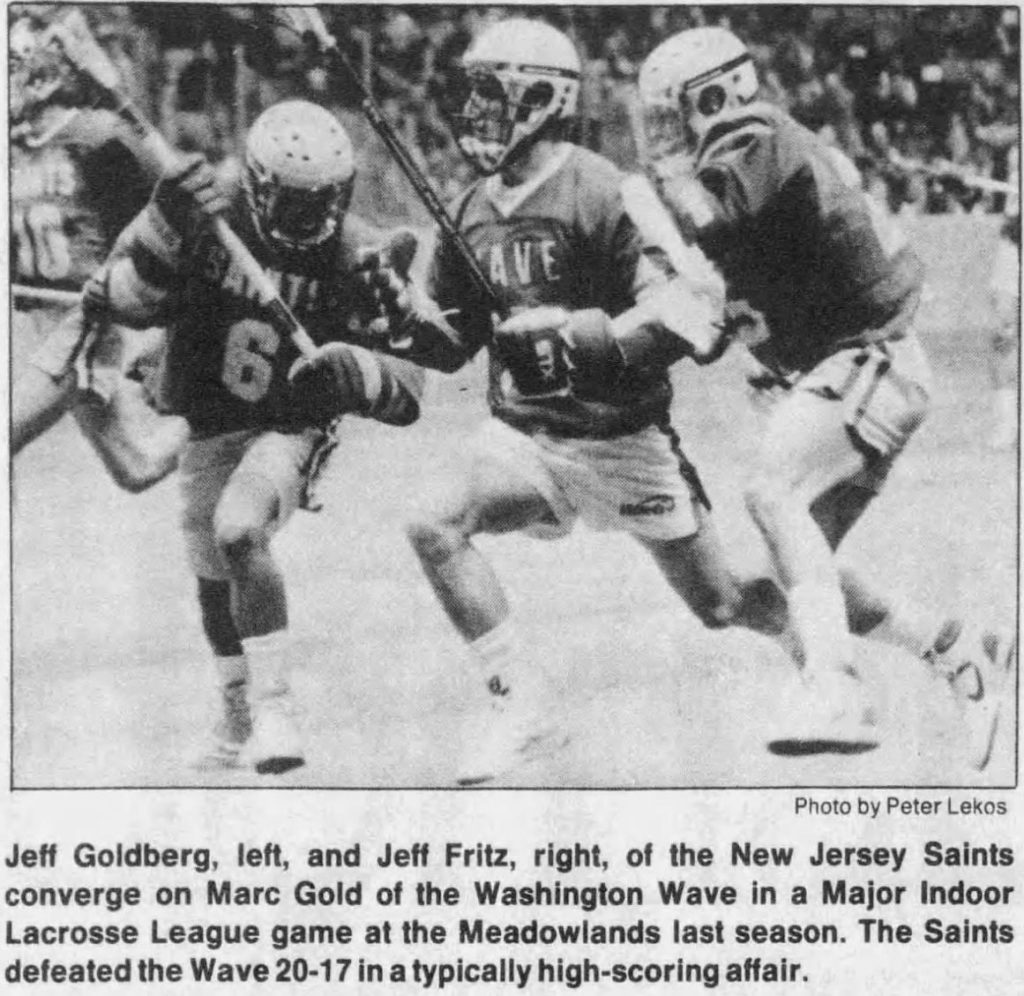
Spectators who came 10 minutes late to a recent Major Indoor Lacrosse League game at the Meadowlands missed seven goals.
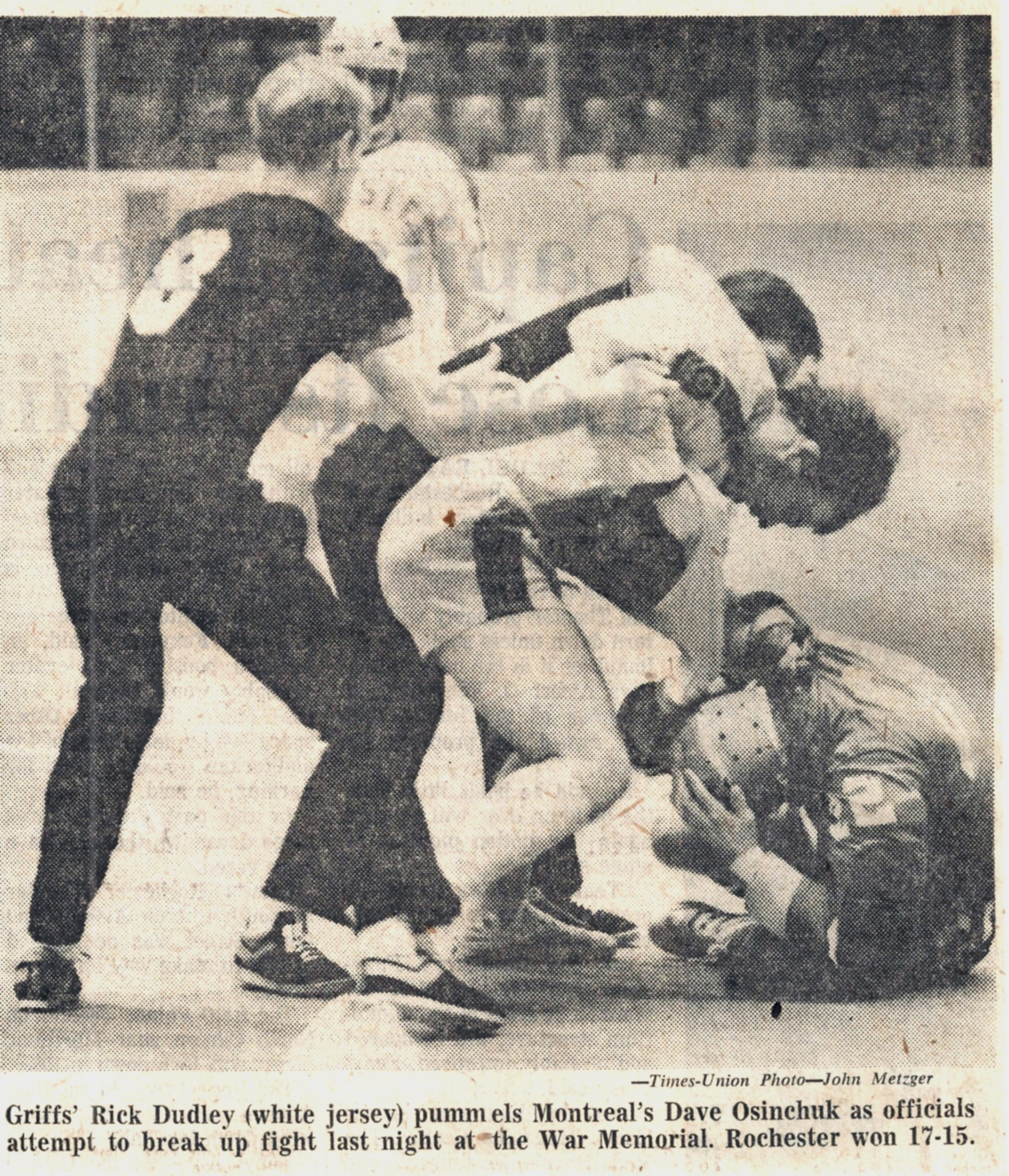
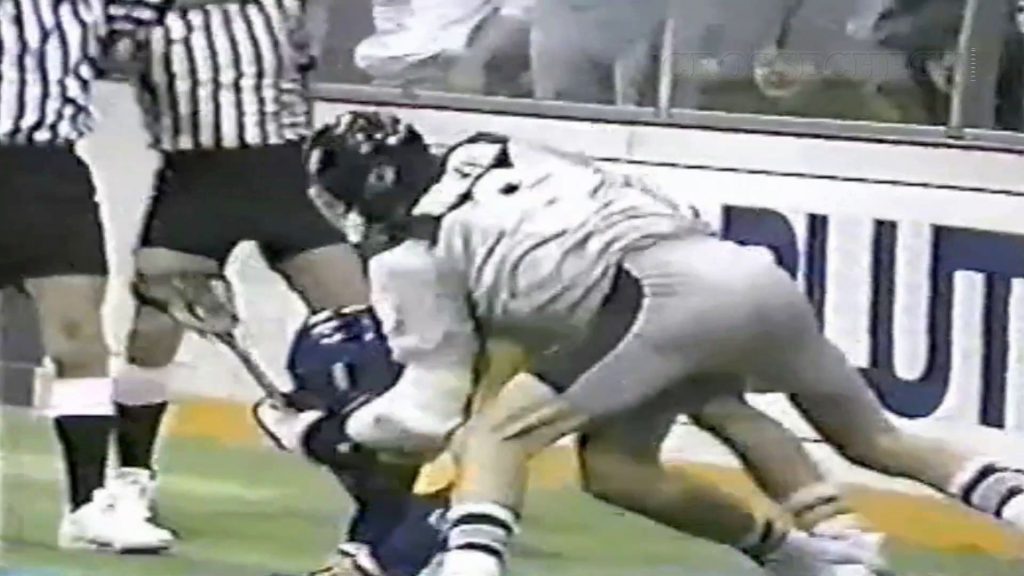
Those who arrived 20 minutes late missed four more goals and a fight that was finally stopped when two referees tackled a New Jersey Saints player to the Astroturf.
Still, there was plenty of action for the latecomers.
In fact, that game between the Saints and the Washington Wave featured 40 goals, 135 shots on goal, 26 penalties, two fights, two ejections, three injuries, countless body checks and one thrown towel by the Wave’s coach.
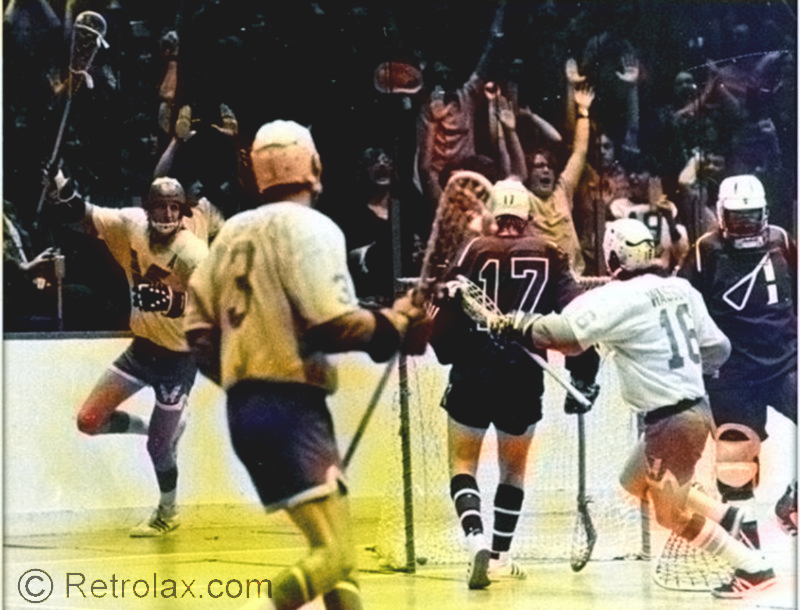
And if this didn’t excite the announced crowd of 5,861, rock ‘n’ roll music punctuated the action — not just between play stoppages but during the game itself.
The purpose of the music — which included the theme from “Miami Vice” and excerpts from the band Genesis — was to not only arouse the crowd but to create a “futuristic” mood.
The result falls short of “Rollerball,” but, judging by attendance figures, fans throughout the MILL are responding to the fast-paced game that is played on an astroturf field the size of an ice hockey rink.
“If you like ice hockey, football, contact and high-scoring sports,” said Chris Fritz, one of the two founders of the MILL, “then indoor lacrosse has everything for you.”
“It’s violence with grace,” said Bill Hunt, 19, about why he likes indoor lacrosse.
The Saints (4-2) play at the Meadowlands tonight at 7:30 p.m. against the Philadelphia Wings (1-4).
The MILL’s slogan is “Making Contact With The Future,” and, with the help of a realistic marketing strategy, the two-year-old league seems to have assured itself of a future, at least for the short term.
“The best way to survive is to deal with as few people from management level to owners as possible,” Fritz said. “You have to be careful about having too many games, too many egos and expensive operations.”
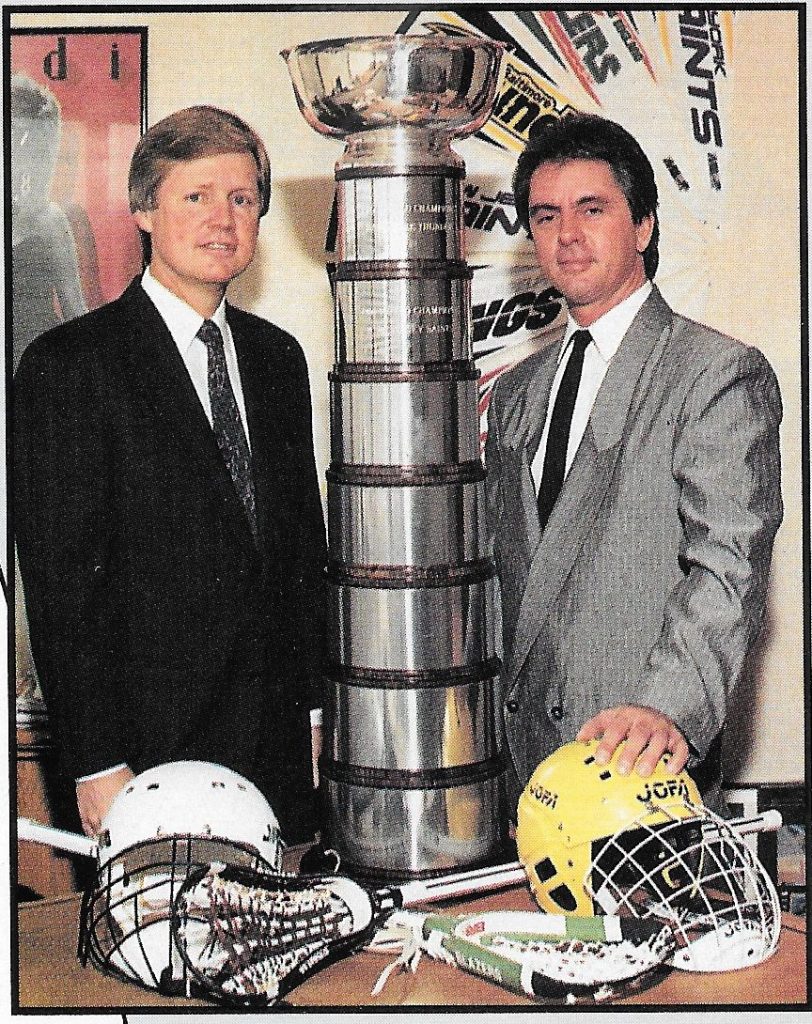
That’s why Fritz and his partner, Russ Cline — both of whom are Kansas City-based concert promoters with no prior affiliation with lacrosse — own all four teams (the Wave, Saints, Baltimore Thunder and Wings).
This way they can monitor potential problems — such as ego-clashing owners, overexpansion, poor marketing, overspending and an over-reliance on foreign players — that undermined a previous attempt at professional indoor lacrosse in the mid-1970s. That league, which some say was more akin to professional wrestling than hockey, failed after two years.
“I remember seeing one of those games at the Capital Centre about 10 years ago,” said Marc Opfello, 33, who attended a Saints game. “The fans were tearing the covers off the seats and throwing them on the field.”
By limiting teams (four), games (eight) and salaries (players are paid $150 per game), Fritz and Cline can minimize their initial investment while the league gradually gains exposure. In fact, Fritz said most of their $1 million-per-year investment goes toward advertising, which is primarily aimed at males from the ages of 18 to 34.
This advertising, which locally includes spots on “The David Letterman Show” and WFAN radio, helped attract an average of 6,691 fans for four Saints games at the Meadowlands last season. The average attendance for the MILL last season was 8,304.
“We were pleasantly surprised by the crowds,” said Jay Rosenfeld, who works in the public relations department of the Meadowlands Sports Complex. “As long as there are no scheduling conflicts, I don’t know why we wouldn’t stay involved next year. We haven’t lost money.”
In the MILL the league arenas (Meadowlands, Capital Centre, Spectrum and Baltimore Arena) act as partners, in that they provide the building and services, such as public relations, in return for a share of the receipts.
To help defray expenses, the league has attracted several corporate sponsors, including Coors Light, STX (lacrosse equipment) and USAIR.
According to Rosenfeld, about eighty percent of the Saints customers are “walk-ups,” meaning they buy their tickets (which cost between $13 and $15) at the window on the day of the game.
Some spectators, like Harvey Cohen, the president of the U.S. Club Lacrosse League, already have an active interest in the sport.
Other fans, like Joseph Gastelu, 12, of Rutherford, saw an advertisement for the sport and persuaded his father to take him.
“There was too much violence last year, but they’ve tried to cut it down. For instance, they no longer allow cross-checking from the rear,” said Cohen, who has been involved with field, or outdoor, lacrosse for 50 years. “I think this sport will catch on. You have some of the best players in the world playing.”
“I’d rather see the Saints than the (New Jersey) Devils,” Gastelu said. “The Saints are better.”
To run their teams, Fritz and Cline attracted some of the top lacrosse talent in each local area.
For example, Tom Flatley — whose coaching credentials include four championships at Sewanhaka High School in Floral Park, N.Y., and two world titles as head coach of the U.S. team — was selected as general manager for the Saints.
He, in turn, picked Bob Engleke, a two-time All-American at Adelphi University, as coach.
Most of the Saints players are from Long Island, which is known for its strong lacrosse programs at the club, high school and college levels. In fact, several of the Saints — including Larry Quinn, Matt Crowley, Randy Natoli and Norm Engleke — played on the U.S. National (outdoor) Lacrosse Team.
Most of the players are college graduates, and many hold white collar jobs. Dave McCullough, for example, is a trader assistant for Oppenheimer on Wall Street. (“The guys from the office sometimes bring clients to the games,” he said).
The main difference between the MILL and the outdoor version is there are just six players on each team indoors. As in hockey, MILL players enter and leave the field “on the fly.” Balls rebound off the boards and plexiglass at speeds approaching 90 miles per hour so speed and adept stickhandling are requisite.
Even though a professional outdoor lacrosse league is starting this summer, the MILL is planning to expand by at least one team next season, according to Fritz.
“Our five-year plan is to have a minimum of 12 to 14 teams,” said Fritz, who hopes to add a third partner to the league. “But we’ll move ahead with caution. We won’t let egos get in the way.”
NOTES: One Saints player, Rich Mullen, is from Mamaroneck. Mullen graduated from Rye Neck High School in 1980 and then attended C.W. Post, where he is now an assistant coach … Lacrosse was originally an Indian game, its roots going further back than baseball and football. Known as “Little Brother of War,” lacrosse was used by Indians to train for combat.